How Mini Excavators Handle Tight Spaces Better
Some of the most valuable work happens in the most awkward places. A drainage trench tucked behind a finished home, a foundation cut between two existing structures, a utility line that has to thread past a fence, a patio, and a row of mature trees. These confined jobsites are exactly where larger equipment runs out of room and crews are forced back to slow, exhausting hand labor. The space is the obstacle, and the wrong machine simply cannot overcome it. This is the precise problem the mini excavator was built to solve, and it does so better than any other piece of equipment on the market.
This guide is written for contractors, landscapers, property developers, remodelers, and small construction business owners who routinely fight for room on the job. We will examine how compact size and narrow track width unlock access others cannot reach, how a tight turning radius and zero tail swing let the machine work safely against walls and structures, how rubber tracks protect the surfaces around it, and why precise operator control and broad versatility make these machines so productive in restricted areas. By the end, you will understand exactly why a mini excavator outperforms larger equipment whenever space is at a premium.
Compact Size That Reaches Where Bigger Machines Stop
Most demanding work no longer happens on wide-open ground. It happens in fenced backyards, along narrow side yards, between closely set buildings, and in dense urban lots where every inch of clearance is accounted for. A standard backhoe or full-size excavator was never designed for these conditions. It cannot fit through a typical gate, slip past a corner of a house, or maneuver around a pool and a deck without risking serious and expensive damage to the property. When the machine is too big for the space, the job either slows to a crawl or gets turned away entirely.
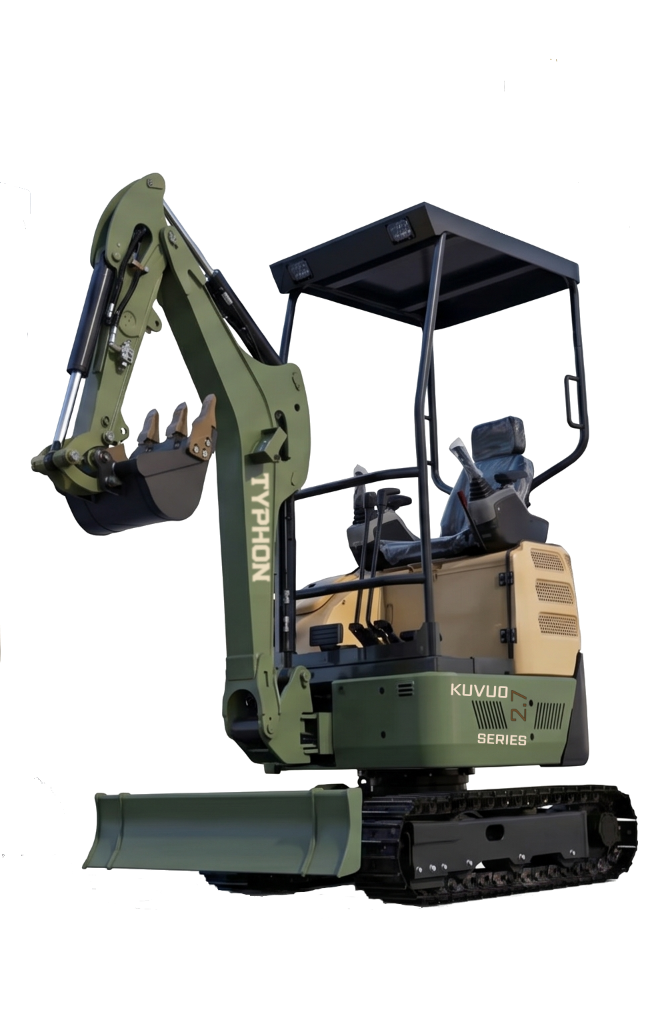
The mini excavator's compact footprint changes that equation completely. With a short chassis, low profile, and tight overall dimensions, these machines move comfortably in areas where larger equipment feels trapped. The advantage is not just that they fit; it is that they bring real mechanical digging power directly into spaces that previously demanded shovels and wheelbarrows. Work that once tied up a crew of laborers for a full day can often be handled by a single operator in a fraction of the time, with far less physical strain on your team.
The business impact is immediate and measurable. When you can reach the work zone with a capable machine, you complete jobs faster, reduce labor costs, and lower the risk of injury that comes with heavy manual digging. Just as importantly, you can confidently bid on confined projects that competitors with only large equipment have to decline. Access becomes a genuine competitive advantage, and that advantage begins with how narrow the machine can make itself.
Narrow Track Width and Expandable Undercarriages
Fitting into a tight space often comes down to a single critical measurement: how wide the machine is at its narrowest point. A standard residential gate, a path between a house and a fence, or a doorway into a basement leaves very little margin, and a machine even slightly too wide is stopped cold at the entrance. For crews who regularly work behind structures, track width quietly determines which jobs are possible and which are not.
Mini excavators address this directly through narrow track designs and, on many models, expandable undercarriages. The undercarriage retracts to squeeze the machine through openings as tight as a standard doorway, then widens once the machine reaches the work area to provide a stable, planted base for digging and lifting. This single feature resolves the central tension of confined work, which is the conflict between needing to be narrow enough to enter and wide enough to stay stable while operating. You get both, in the same machine, on the same job.
The practical effect on your operation is substantial. A retractable undercarriage means you no longer have to choose between access and stability, and you no longer have to dig by hand simply because nothing mechanical fits through the gate. You bring the machine in, expand it, and work with the confidence that it will not become unstable under load. That ability to enter tight openings and then perform like a larger machine is a defining reason mini excavators excel where space is restricted, and it pairs naturally with how easily they turn once inside.
COMMENTS (1)
please advice
LEAVE A REPLY